It seems that, when it comes to lakes, Canada always has something to surprise. Osoyoos, a tiny town in British Columbia, would have very little to offer the thousands of tourists who reach it all year round were it not for the natural phenomenon represented by the Spotted Lake: a freak of nature, which, however, reveals the less predictable and compliant aspects.
A work of art, of its kind, even if it is the result of the natural chemical reaction of the many elements that make up the habitat of the basin and its immediate surroundings. Never has a name been more appropriate: the surface of Lake Osyoos is actually made up of dozens and dozens of colored spots, visible especially during the summer months when the high temperatures and more favorable weather conditions evaporate the water and lay bare what is found in the immediately following layers.
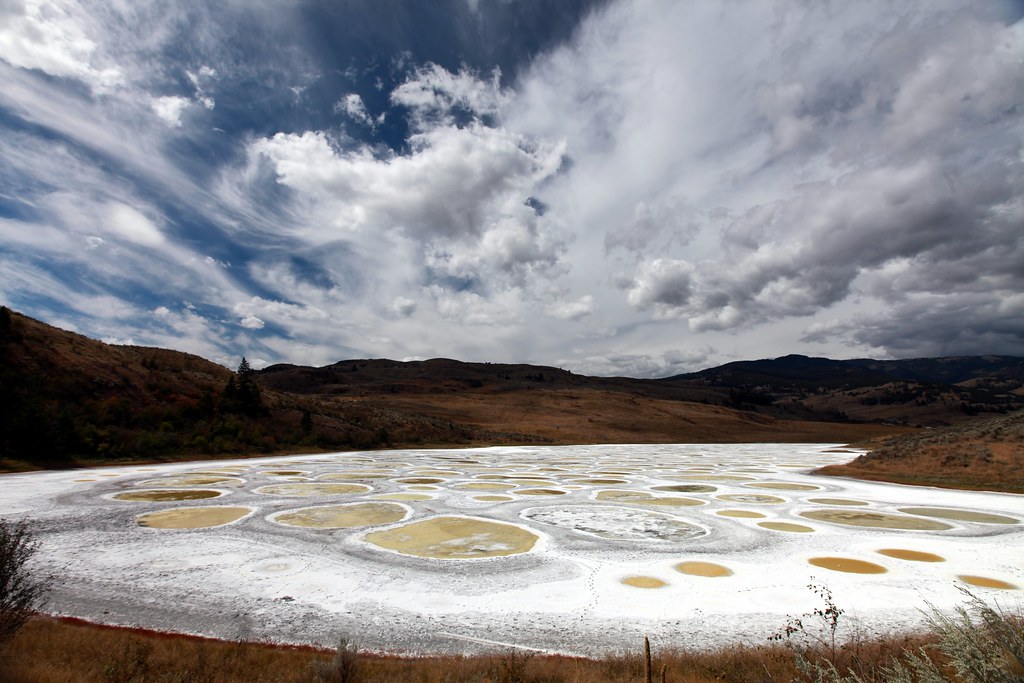
The phenomenon extends over the entire width of the basin, which is however of modest size. But the spectacle that can be admired from its waters is not modest: it is the great variety of minerals present in it that creates that kaleidoscope effect that attracts tourists to those parts. The different coloring of its spots is in fact due to the predominance of one substance over the others in that specific point of the lake and above all to its concentration: this is why the spectacle offered can change from day to day depending on the specific climatic conditions. Depending on the mineral composition these spots are white, yellow, green, or blue, randomly distributed on the surface.
To create the natural walkways that allow the individual stains to be isolated and to give life to the particular phenomenon is magnesium sulfate, present to a preponderant extent compared to other agents, which crystallizes and hardens in summer especially. However, it is impossible to take a stroll inside: the lake, since the procession of visitors began, has been appropriately fenced and today it is possible to admire its characteristics only from the outside.

A precaution that has prevented the disappearance of the phenomenon and indeed has intensified the events, to the delight of those perched on the railings to enjoy the show. Until a few decades ago, the natives immersed themselves in its waters, rightly believing that they possessed therapeutic qualities, and in fact, there is no spa in the world that has similar characteristics. But then the same visitors realized that the human presence risked damaging that particular environment and prevented anyone from approaching, even those who had exploited its resources by drawing heavily on that reservoir, for example, to recover minerals. useful for the production of ammunition (it is said in this regard that during the First World War the workers were able to take away from the lake up to one ton a day of material).

It goes without saying that, precisely because of its particularity, the stained lake was at the center of a long legal dispute, especially when it was bought by a private individual: the natives organized a collection and managed to collect the sum necessary to buy it, to fence it and declare it sacred.
Because in fact, such a spectacle cannot be more than divine in nature.