When the holds of rationality are missing and logic fails to penetrate the veils of apparent incomprehensibility, the paranormal solution immediately opens up, the one that does not require justifications or counter-proofs.
Just throw it there and that’s it, as long as someone, annoyed by so much superficiality, doesn’t start wanting to see us more clearly. This is what happened in the long-standing story of the so-called Chilean saywas, or mysterious piles of stones arranged at regular intervals in the Atacama desert without apparent meaning.
There has never been any doubt that they were human artifacts, just as there has never been any doubt about the fact that they were created by individuals who lived several centuries ago. One has always groped in the darkness of reason as to why those stones were accumulated. As usual, the simplest ones have tried to justify those piles with the inevitable extraterrestrial theory: in the absence of certain evidence, there have been those who went so far as to argue that it could be explicit signals to mysterious beings for the landing of their spaceships, a sort of rudimentary runway to be used on arrival and departure.
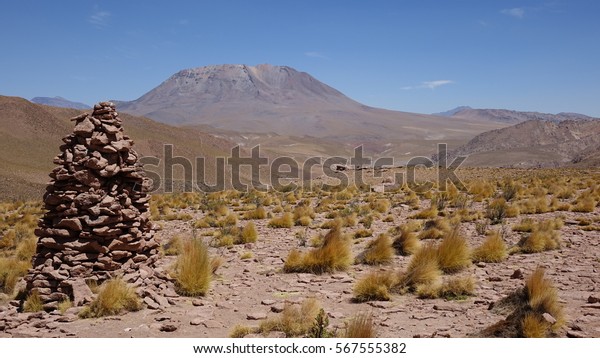
It was enough to bring up some old legend with unclear contours and the game was done. Those carefully stacked alignments of stones present in the desert for at least five hundred years had found no other kind of justification and so on with the alien theory. Throughout the rest of the world the saywas, or cairns or montjoie or Quechua, were used to delimit territories or to indicate the presence of sacred places.
Finally, someone began to investigate, discovering that for the saywas of the Atacama desert, experiences of this type could not be brought up: too precisely aligned to perform that function; and not even the milestone hypothesis was very convincing. There had to be more: and so the director of the Pre-Columbian Art Museum of Chile tried alternative ways, getting help in her research from some ancient documents in which those mysterious piles of stones were mentioned, but above all by the astronomers of the Atacama Large Millimeter Array, a gigantic network of antennas placed in the desert that forms one of the most powerful telescopes in the world.

It was science, therefore, that gave its decisive contribution to unraveling the mystery: it was discovered that on some precise dates the sun at its rise aligned perfectly with the saywas, a hypothesis confirmed by inspections on the ground. Historians and astronomers met on the day of the autumn equinox of 2017 (it was 22 September) in Vaquillas and were able to see that at sunrise its rays traced a line that intercepted all the piles of stones to the millimeter. The same happened during the winter solstice in a nearby area. In short, it was a solar calendar with which pre-Columbian civilizations managed to manage the passage of time.
An interpretation that found definitive confirmation when an anthropologist was able to justify the presence of a third row of saywas that apparently did not indicate any particular date in our calendar. And instead, he indicated it: it was August 1st, the day dedicated to the divinity Pachamama.
In fact, a shred of irrationality was needed to avoid making such a fascinating story excessively sterile …